Introduction
Most outbound sales reps spend their day inside a CRM. It's where they log calls, update opportunities, and manage their pipeline. A CRM is an essential sales tool, but it's important to understand what it was designed to do—and what it wasn't.
The difference becomes obvious when you compare its purpose with that of a real-time productivity tool.
The Short Version
A CRM is indispensable for managing customers, opportunities, and forecasting. But because it records activity after it happens, it can't help an outbound sales rep recover from lost productivity during the day. Real-time productivity tools fill that gap by monitoring call pace, talk time, idle time, and progress toward daily goals while there's still time to adjust.
CRM vs. Real-Time Productivity
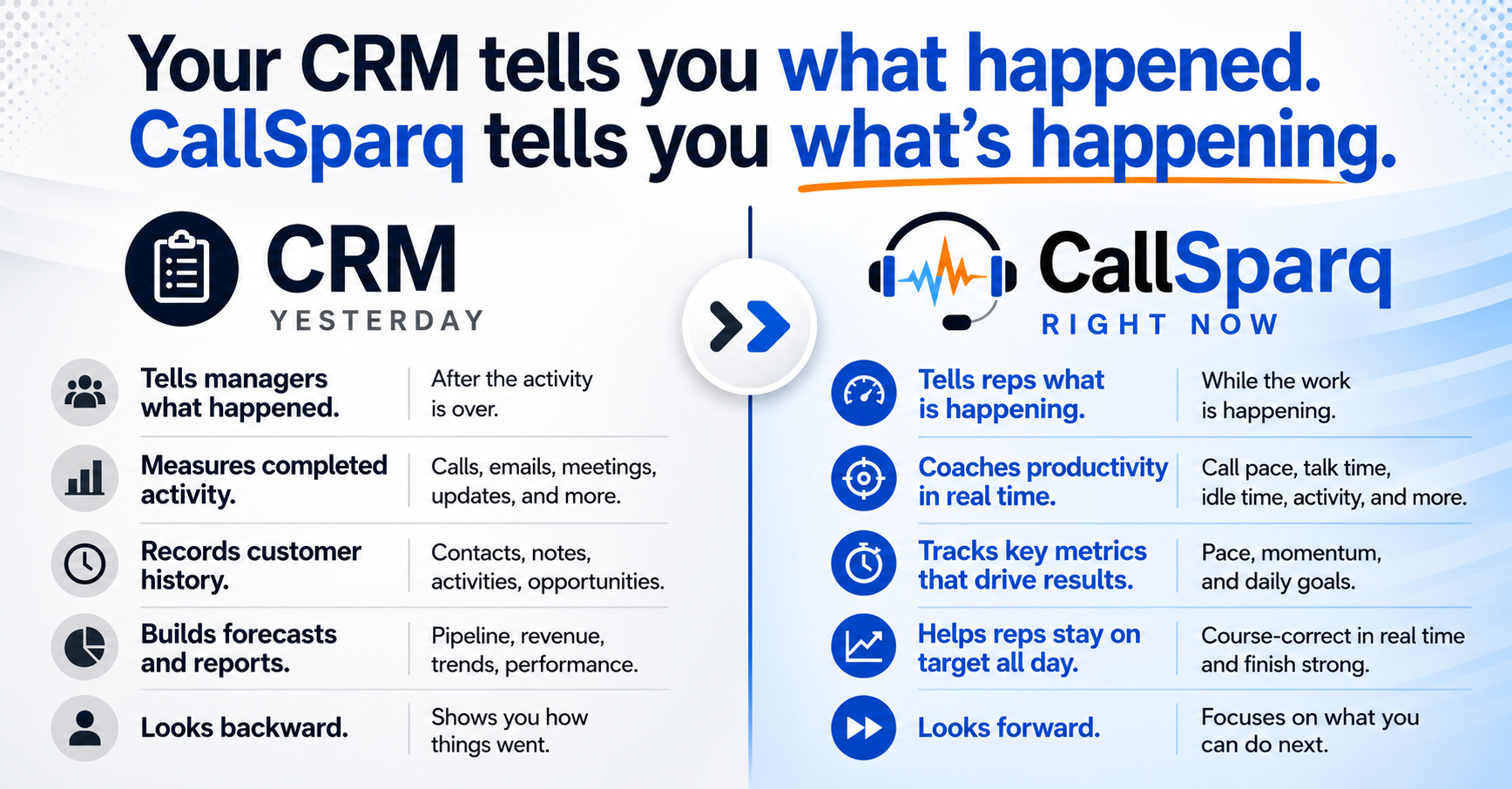
Your CRM...
- Tells managers what happened.
- Measures completed activity.
- Records customer history.
- Builds forecasts and pipeline reports.
- Looks backward.
CallSparq...
- Tells reps what is happening.
- Coaches productivity in real time.
- Tracks call pace, talk time, and idle time.
- Helps reps stay on target throughout the day.
- Looks forward.
Neither approach is wrong. They're simply solving different problems.
Why This Matters
A CRM is a system of record. It captures information after an activity has taken place, making it invaluable for pipeline management, forecasting, reporting, and customer history. Without one, most sales organizations would struggle to operate effectively.
The challenge is that outbound sales isn't won by reviewing yesterday's activity. It's won one call at a time, throughout the day.
The 2:30 PM Problem
Imagine you're halfway through the afternoon. You've had a couple of good conversations, answered a few emails, and updated several opportunities. You feel productive, yet you've unknowingly spent six or seven extra minutes between calls throughout the day.
Those small delays accumulate, and suddenly you're well behind your call goal. Your CRM faithfully records every activity, but it never tells you that your pace has slipped while there's still time to recover.
Measuring Performance vs. Influencing Performance
That's the difference between measuring performance and influencing performance.
Think of a CRM as the official scorekeeper. It tells everyone how the game went after it's over. But if you're the one on the field, you need something different. You need to know whether you're slowing down, whether you're still on pace, and whether a few small adjustments now will change the outcome before the final whistle.
That's exactly what real-time productivity tools are built to do. By continuously monitoring call pace, talk time, idle time, and progress toward daily goals, they give outbound reps immediate feedback while those metrics are still actionable. Instead of discovering at 5:00 PM that you missed your target, you recognize at 2:30 PM that you're drifting off pace and can immediately correct course.
How CallSparq Fits In
That philosophy is what drove the creation of CallSparq. It isn't intended to replace your CRM—it complements it. Your CRM continues to manage customers, opportunities, and pipeline. CallSparq focuses on helping the outbound sales representative make better use of every hour, maintain momentum, and finish the day on target.
Conclusion
Both tools are valuable. They simply answer different questions. One asks, “What happened?” The other asks, “What's happening, and what should I do about it?”
For an outbound sales rep trying to hit today's goals, that distinction can make all the difference.