
What Sales Productivity Really Means
Most sales organizations want the same thing: greater sales productivity. Ask ten sales leaders what that means, however, and you'll likely hear ten different answers.
Some define sales productivity as generating more revenue with the same number of salespeople. Others point to quota attainment, opportunity creation, pipeline growth, or calls completed. Modern CRMs can produce dashboards full of productivity metrics, while AI platforms promise to automate administrative work so reps can spend more time selling.
None of these perspectives are wrong. In fact, they're all measuring something important. The problem is that they often describe productivity after the fact. By the time the reports are generated, the calls have been made, the opportunities have been won or lost, and the workday is over.
The Short Version
Sales productivity isn't simply about making more calls. It's about turning working time into meaningful selling activity. While most sales tools measure yesterday's performance, the greatest improvements happen when sales reps can see today's pace, talk time, idle time, and progress while the workday is still unfolding. That's the gap real-time productivity tools like CallSparq are designed to fill.
For an individual sales representative, that creates an obvious question: What can I do differently right now? That question receives surprisingly little attention, yet it's the one that ultimately determines whether today's numbers will become tomorrow's report.
At its core, sales productivity is the ability to turn working time into meaningful selling activity that produces results. Revenue will always be the ultimate objective, but revenue is influenced by countless factors that extend beyond the salesperson's immediate control: territory, pricing, product-market fit, competition, marketing quality, and simple timing.
Activity, on the other hand, is largely controllable. An outbound sales representative decides whether to make the next call immediately or wait another five minutes. They decide whether to stay focused after a difficult conversation or drift into email, research, or social media. They decide whether a short administrative task remains short or quietly expands into twenty minutes.
None of those individual decisions seems especially important. Collectively, they define the rhythm of an entire day.
Measuring Activity Isn't the Same as Improving It
Modern sales organizations have no shortage of information. CRMs record customer interactions, dialers count calls, conversation intelligence platforms analyze meetings, and business intelligence systems generate detailed reports. Managers can review dashboards showing activity by representative, team, territory, or region.
These systems are extraordinarily valuable. Without them, managing a sales organization at scale would be nearly impossible. Yet they all share one characteristic: they primarily explain what has already happened.
Imagine trying to improve your driving by studying yesterday's GPS route after arriving home. You might discover where traffic slowed you down or where you took an inefficient route, but none of that helps you avoid the traffic jam that you're sitting in today.
Sales productivity works much the same way. A report showing that a representative spent ninety minutes idle yesterday may help explain disappointing results, but it cannot recover those ninety minutes. By the time anyone notices the problem, the opportunity to change the outcome has already disappeared.
This is one of the reasons why coaching often feels reactive. Managers review completed activity, identify patterns, and suggest improvements for tomorrow. That process certainly has value, but it leaves a significant gap between the moment a productivity problem begins and the moment someone recognizes it.
Why Small Gaps Matter
Many sales professionals assume that poor productivity results from large mistakes. In reality, it's usually the accumulation of much smaller ones.
A call ends, and instead of placing the next one, a representative decides to clean up a few CRM notes. While there, an email notification appears. That leads to researching an account, which reminds them to update another opportunity. A conversation with a coworker follows, then a quick trip for coffee, and before long twenty minutes have quietly disappeared.
Nothing in that sequence feels unreasonable. In fact, every individual activity could probably be justified. The problem is that productivity isn't lost in large blocks. It's lost in small, seemingly harmless decisions repeated throughout the day.
Ask almost any experienced outbound salesperson whether they've ever looked up at the clock and wondered where the last half hour went, and they'll probably smile. It happens to everyone. The difference between average performers and consistently productive ones is not that distractions never occur. It's that productive salespeople recognize them sooner and return to selling more quickly.
Leading Indicators Change Outcomes
Sales organizations naturally celebrate lagging indicators. Revenue, quota attainment, closed business, and pipeline growth all deserve attention because they're the outcomes every company ultimately cares about. The difficulty is that none of them can be changed once they've occurred.
Leading indicators are different. They represent behaviors that influence future results while there is still time to adjust them. Calls completed, meaningful conversations, talk time, time between calls, and daily pace toward activity goals don't guarantee revenue, but they strongly influence whether revenue becomes more or less likely.
Professional athletes understand this instinctively. A golfer cannot change yesterday's scorecard, but they can adjust their swing before the next shot. A marathon runner cannot recover a slow first mile, but they can monitor their pace closely enough to prevent the race from slipping away.
Sales is no different. Representatives who understand where they stand throughout the day can make small course corrections before those adjustments require heroic effort during the final hour.
Why Real-Time Visibility Matters
Suppose a representative discovers at 4:45 in the afternoon that they're twenty calls behind goal. The information may be accurate, but it isn't especially useful. The workday is nearly over.
Now imagine that same representative recognizing the trend at 9:30 in the morning. Suddenly the situation is entirely different. Perhaps the pace simply needs a slight adjustment. Perhaps unnecessary idle time has begun creeping into the day. Perhaps longer conversations require temporarily reducing administrative work between calls. None of those changes requires extraordinary effort, but they all require timely awareness.
The earlier a productivity issue becomes visible, the easier it becomes to correct. That distinction may sound subtle, yet it changes the role technology plays in the sales process. Instead of serving only as a historical record, technology begins acting as a guide while the work is actually being performed.
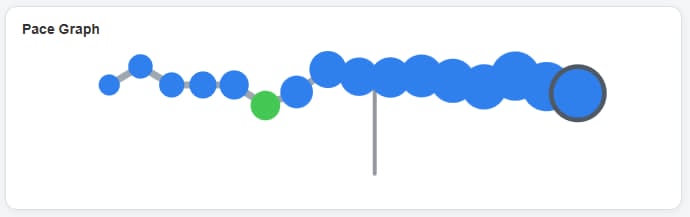
The Pace Graph shown above represents what that looks like on a strong day. The representative stayed close to or ahead of goal pace throughout the shift and finished above target. More importantly, the graph made that pace visible while the day was still unfolding, not after it was over.
Where CallSparq Fits
CallSparq was built around a simple observation: most sales tools explain yesterday remarkably well, but very few help representatives improve the next fifteen minutes.
It isn't intended to replace a CRM, a dialer, or a conversation intelligence platform. Those systems remain essential because each serves a different purpose. Instead, CallSparq focuses on the period that often receives the least attention—the workday itself.
By continuously displaying call pace, talk time, idle time, and progress toward daily activity goals, it gives representatives immediate visibility into the behaviors that shape productivity before the day is finished. Small adjustments become possible while they still matter. Managers spend less time discovering problems after they've occurred, and representatives spend less time wondering whether they're on track.
The result isn't simply better reporting. It's better decisions.
Looking Beyond the Dashboard
Every sales organization measures productivity. The question is whether those measurements merely describe performance or actively improve it.
Historical reporting will always have an important place. Companies need accurate records, reliable forecasting, and meaningful analytics. Those capabilities are indispensable. But productivity isn't created inside yesterday's reports.
It's created in the minutes between one customer conversation and the next, in the countless small decisions that determine whether momentum continues or quietly slips away. When salespeople can see those moments clearly enough to change them while the day is still unfolding, productivity stops being something that's measured after the fact. It becomes something they actively manage.
And that's where meaningful improvement begins.